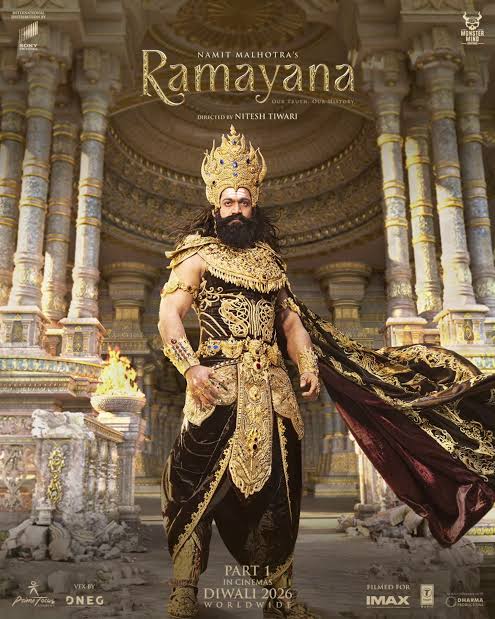


Ramayana: Part 1 is based on the ancient epic Ramayana by Valmiki and is directed by Nitesh Tiwari, who has co-written the screenplay with Shridhar Raghavan. Produced by Namit Malhotra and Yash.
Perhaps every individual in this vast country knows this one story. An epic that has traversed thousands of years and continues to evoke passion and emotion, whether through the pages of a book or the marathon hours spent watching it on the small screen. Now, we have a film that supposedly intends to educate the world about one of the two greatest stories ever told to humankind, the other being the Mahabharata.
And therein lies the challenge. How do you present a story that practically every Indian has known since the age of five? The makers, armed with technology and a budget that could probably fund a small kingdom, seem to have arrived at one conclusion: make every inch of the big screen sizzle with magnificence. And magnificence there is, in abundance.
But somewhere along the way, the makers seem to have forgotten that the Ramayana isn’t a story waiting to be discovered by Indians. It is a story that has been lived, heard, debated and cherished across generations.
Perhaps this film was made less for the audience here and more for the viewers across the world. For a global audience, the visual extravaganza may well be an introduction. But for the Indian audience, this is a familiar tale of good versus evil, whose soul lies in love, sacrifice, obedience and dharma. You cannot replace these with a million colours, elaborate sets and computer-generated splendour and expect the audience to be overwhelmed.
The Ramayana isn’t a story about gargantuan scale or a bevy of complex characters trying to outdo one another, as in the Mahabharata. It is essentially a linear narrative whose simplicity is its greatest strength. Its deeper philosophical undertones are what make it worthy of interpretation and debate. Unfortunately, Namit Malhotra’s Ramayana conveniently bypasses much of this depth and skims through the pages of the epic, seemingly more interested in creating a cinematic experience than an emotional one for the global audience. It is high on style, but short on substance; high on energy, but rather low on soul.
Ranbir Kapoor, ironically, feels lost as Prince Ram and is perhaps more at home once he is lost in the forest. Despite the role being seemingly tailor-made for a restrained performance, Ranbir struggles to convey the self-effacing Prince who demonstrated resilience, strength and divinity through his eyes without having to dramatise it. He appears rather clueless in those moments. He gets back into his element only when the emotional demands of the narrative offer him more scope.
Yash as Ravana has a far easier outing. A man who has practically owned the gangster persona in Indian cinema now brings majesty and intensity to Ravana, while managing to keep the performance wonderfully restrained. He commands attention without having to demand it.
Sai Pallavi is decent as Sita, though she suffers from some of the same shortcomings as Ranbir. Ravi Dubey does well, while Arun Govil as Dasharatha brings maturity and restraint to the role. He offers a lesson in acting to those around him, demonstrating that a character need not be loud or dramatic to leave an impression. Sometimes, warmth, dignity and a measured expression can do far more than a hundred dramatic flourishes.
Technically, a film mounted on a budget of such humongous proportions does justice to every rupee spent. Cinematography by Pankaj Kumar and Mahesh Limaye meets the demands of a global spectacle, with frames that are extravagant and full of panache. The songs and background score by Hans Zimmer and AR Rahman, with sweeping Western orchestration and dollops of Sufi influence, unfortunately fail to move the heart. The music seems more intent on matching the visual grandeur than creating an emotional connection. When the visuals are already screaming for attention, the music needn’t join the competition.
Dialogues are ordinary. Editing by Huzefa Lokhandwala is neat, while the direction, with Namit Malhotra at the helm, is limited in its ability to extract the emotional depth that this epic demands.
Ramayana is a mixed bag. There are moments when the sheer scale and technical dexterity overwhelm you. But an epic of this magnitude needs more than breathtaking visuals and a seemingly bottomless budget. It needs a heart that beats to the rhythm of the story. And that is precisely where the film falls short.
You may leave the theatre impressed by what you have seen, but not necessarily moved by what you have experienced. And for a story that has moved generations, that is quite an irony.
The makers have given us a spectacle to behold, but the soul seems to have taken a vanavaas of its own. One can only hope Part 2 brings it back.
RAMAYANA – RAMBUNCTIOUS!
3/5
B.U. Shreesha



Leave a Reply