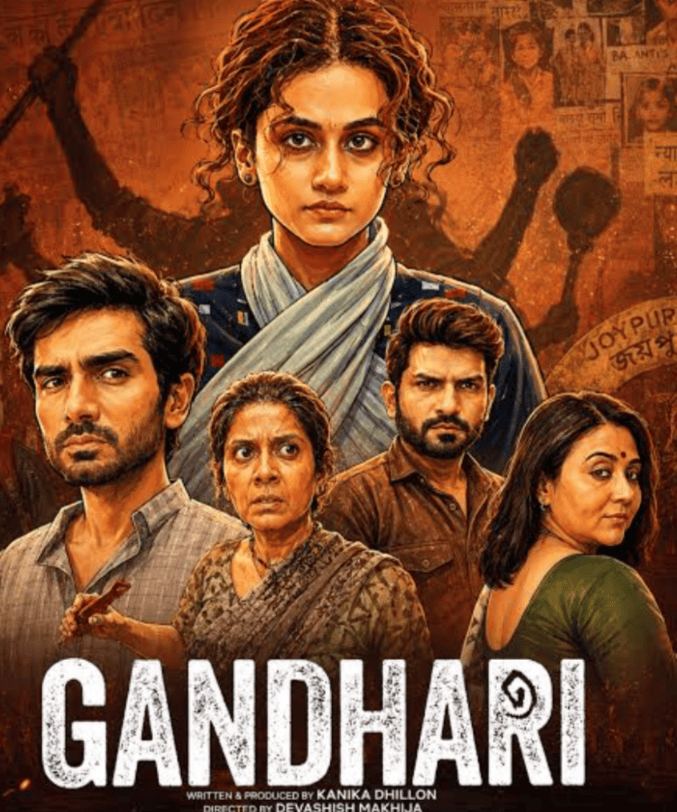


Gandhari is one of those movies that starts with a very simple emotion and slowly turns it into something much bigger. At its core, this is a story about a mother who refuses to give up when her daughter disappears. And honestly, that emotional foundation is what makes the movie interesting.
The film doesn’t try to present motherhood as something soft and sentimental all the time. Instead, it asks a more intense question — what happens when a mother’s fear turns into anger, and that anger gives her the strength to fight back?
That idea works really well.
But while Gandhari has a strong concept and some genuinely engaging moments, the movie doesn’t always manage to deliver the powerful experience its premise promises.
The Story
The story revolves around Bani, played by Taapsee Pannu, whose daughter goes missing. What begins as a desperate search slowly takes her into a world filled with secrets, crime and people she cannot easily trust.
Bani isn’t someone who suddenly becomes a superhero. Her journey is driven by desperation. She is scared, angry and emotionally exhausted, but she simply refuses to accept that her daughter is gone.
That part of the story feels very real.
Anyone who has children can probably understand the basic fear behind it. Losing your child, even for a few minutes, can make the world feel like it has stopped. The film takes that fear and stretches it into a much darker situation.
As Bani continues searching, the story becomes much bigger than just one missing child. It touches on child trafficking, exploitation, crime and the silence that allows such things to continue.
This is where Gandhari tries to become more than just a revenge thriller.
Taapsee Pannu Is the Heart of the Film
If there is one reason to watch Gandhari, it is Taapsee Pannu.
She doesn’t play Bani as an over-the-top action character. There is pain behind her anger, and that makes her performance work.
Some of her best moments aren’t necessarily the fight scenes. It is the quieter moments where you can see what Bani is going through without her having to say much.
There is a tiredness in her character. She isn’t fighting because she enjoys violence. She is fighting because she feels she has no other choice.
That difference makes her character more believable.
Taapsee has played strong women before, but Bani feels different because her strength comes from a very basic human emotion — the fear of losing her child.
The Atmosphere Is Interesting
One thing I liked about the movie is the atmosphere.
The fictional town of Joypurra doesn’t feel like just another location where the story happens. It has its own personality.
There is something unsettling about the place, and the filmmakers use its surroundings, local beliefs and mysterious elements to create a sense that something isn’t quite right.
It gives Gandhari an identity of its own.
Instead of making this a straightforward urban crime thriller, the film takes us into a world that feels isolated and unfamiliar.
That was one of the aspects I found more interesting than the actual twists.
Where the Movie Loses Its Grip
The biggest problem with Gandhari is that it tries to do too much.
There is a kidnapping story.
There is revenge.
There is child trafficking.
There is mythology.
There is folklore.
There are social issues.
There are mysterious characters.
There is action.
Individually, these ideas aren’t bad. In fact, several of them are quite interesting.
The problem is that they don’t always come together naturally.
At times, I felt the movie was trying very hard to tell me that there was something deeper happening, instead of simply allowing the story to speak for itself.
The central story — a mother searching for her daughter — is powerful enough.
I sometimes wished the film had stayed closer to that emotional core.
The Emotional Side Could Have Been Better
This is probably the biggest missed opportunity.
The subject matter should have been heartbreaking.
A mother desperately searching for her missing daughter is naturally emotional. There is so much potential for the audience to connect with Bani.
But the film occasionally moves too quickly from emotion to action.
You understand why Bani is angry, but you don’t always feel her pain as deeply as you should.
There are moments when the movie gets close to something genuinely powerful, only to move on to the next plot development.
For me, that’s where Gandhari falls short.
It has the ingredients for a very emotional thriller, but it doesn’t always allow those emotions enough time to sink in.
The Action
The action sequences are decent and Taapsee handles the physical side of the role convincingly.
I liked that the action generally feels connected to the character rather than being included simply to make the film look bigger.
Bani isn’t fighting like someone who has spent her entire life training for combat. Her actions feel more like those of someone pushed beyond her limits.
That gives some of the confrontations a raw quality.
Still, the action isn’t necessarily the reason I would recommend the film.
The emotional journey is supposed to be the real attraction.
The Supporting Cast
The supporting actors do their jobs well, although the film clearly belongs to Taapsee.
Ishwak Singh brings sincerity to his role, but his character doesn’t get the same depth as Bani.
Some of the other characters are more useful for moving the plot forward than for becoming memorable characters themselves.
That’s another area where the film could have been stronger.
A few well-developed supporting characters could have made Bani’s journey feel even richer.
The Title ‘Gandhari’
The title is probably one of the more intriguing aspects of the movie.
The reference to Gandhari from the Mahabharata isn’t just there for decoration. The idea of seeing, not seeing and choosing what to see connects with the film’s larger themes.
There are people who know what is happening but choose to remain silent. There are people who don’t want to confront the truth. And then there is Bani, who becomes determined to see things for what they really are.
I liked the idea behind this symbolism.
I just wish the movie had handled it with a little more subtlety.
What I Liked
- Taapsee Pannu’s committed performance
- The central mother-daughter emotion
- The atmosphere of Joypurra
- The darker tone
- The attempt to combine a social issue with a thriller
- Some effective action sequences
- The mythology and folklore elements
What Didn’t Work for Me
- The screenplay becomes unnecessarily complicated
- Too many ideas compete for attention
- The emotional moments don’t always have enough impact
- Some characters deserved more development
- The film occasionally feels longer than necessary
- The second half doesn’t have the same freshness as the initial setup
Final Thoughts
I went into Gandhari expecting a dark, emotional thriller, and I came away feeling that the movie had a much better story inside it than the final film manages to deliver.
That’s not to say it is a bad movie.
It isn’t.
There are several things to appreciate, especially Taapsee Pannu’s performance and the central idea of a mother refusing to surrender.
But the film tries to carry too many themes at the same time. Because of that, the emotional connection sometimes gets buried underneath the plot, symbolism and action.
For me, the best version of Gandhari would have been a simpler and more emotionally intense film — one that stayed firmly with Bani’s journey and allowed us to experience her fear, desperation and anger more deeply.
Still, Taapsee makes the movie worth watching. She gives Bani enough strength and vulnerability to keep us invested even when the screenplay starts wandering.
Gandhari is not a perfect thriller, but it has a strong emotional core and a committed lead performance.
⭐ My Rating: 3/5
Taapsee Pannu: ⭐⭐⭐⭐
Story: ⭐⭐⭐½
Screenplay: ⭐⭐½
Direction: ⭐⭐⭐
Action: ⭐⭐⭐½
Emotion: ⭐⭐⭐
Overall: ⭐⭐⭐
Verdict: A watchable, dark thriller with a strong Taapsee Pannu at its centre. The idea is powerful, but the execution could have been tighter, simpler and much more emotional.
What stays with you after the movie isn’t really the action or the twists.
It is the thought of a mother who simply refuses to stop looking for her child.



Leave a comment